I was outside the realm of women. I did not dance the way that people danced. I had what I called a contraction and a release. I used the floor. I used the flexed foot. I showed effort. My foot was bare. In many ways, I showed onstage what most people came to the theatre to avoid.
Introduction
Martha Graham. Dancer. Choreographer of 181 works. Artistic Director of the Martha Graham Dance Company. Creator of a movement technique. Founder of The Martha Graham School of Contemporary Dance, the longest continuously operating school of dance in the United States. Author. Visionary. Innovator. Role model.
Born in the 19th century (1894), Graham founded her dance company in the early 20th century (1926), and continues to have a significant presence in the 21st century, more than 35 years after her death (1991).
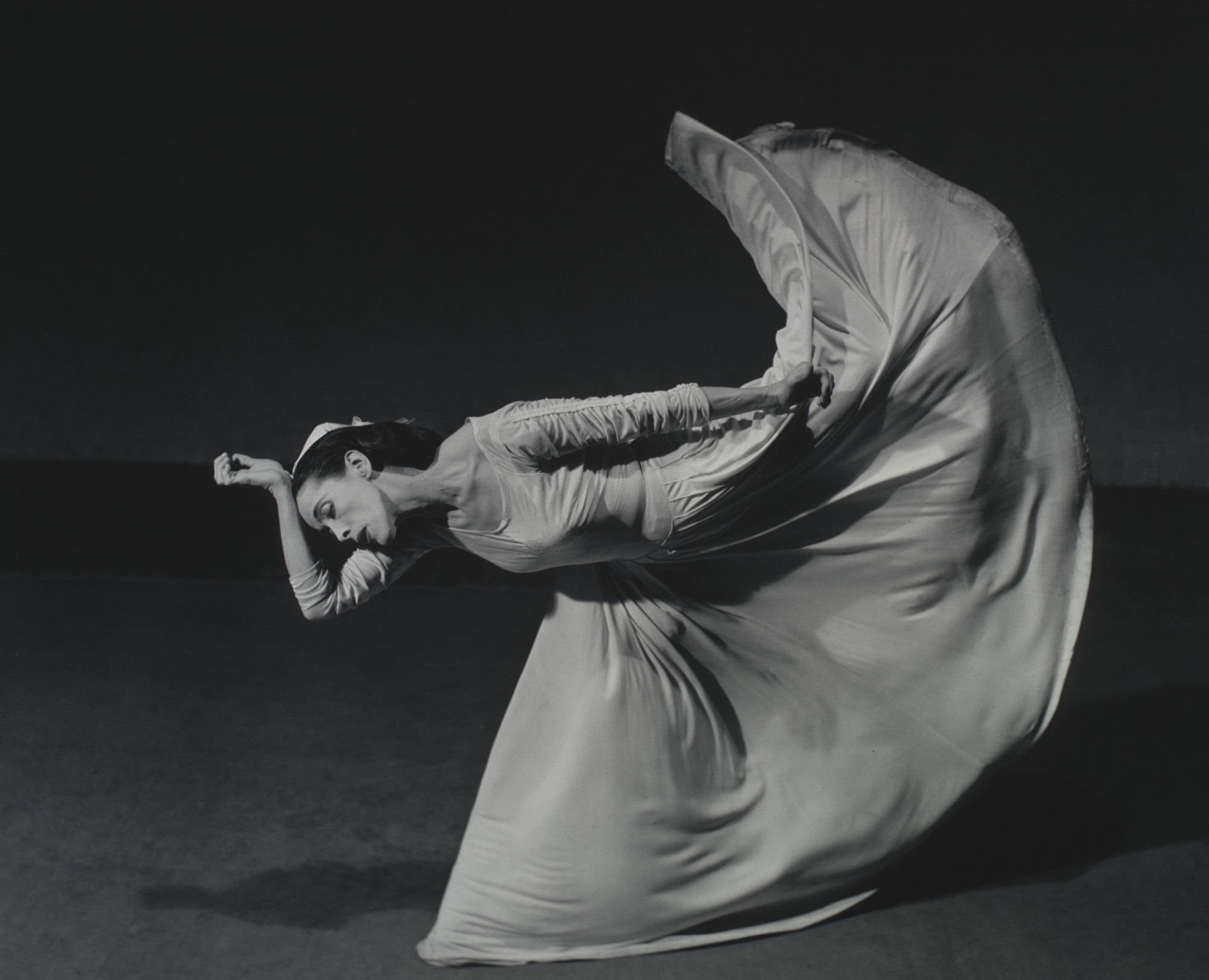
Even people not familiar with modern dance and its history know Martha Graham. From the iconic black and white images captured by photographer Barbara Morgan to the use of her persona in an ad for Apple Computers in their “Think Different” campaign to her portrait on a U.S. postage stamp, people know her. As fellow artist and Graham biographer Agnes de Mille said, “Martha always wanted to leave behind a legend, not a biography.”
Graham’s brilliant work and life as an artist has been contemplated, documented, and written about by scholars, dance critics, collaborators, and historians. Among the many perspectives into her work that can be found on bookstore and library shelves are her autobiography (Blood Memory, 1991), her choreographic sketches (The Notebooks of Martha Graham, 1973), collections of photographs (Martha Graham: Sixteen Dances in Photographs, 1941, photos by Barbara Morgan), as well as numerous biographies, including recent publications from Deborah Jowitt, Errand into the Maze: The Life and Works of Martha Graham (2024) and Neil Baldwin, Martha Graham: When Dance Became Modern (2022). (See these books and many other titles in the Norton Owen Reading Room in the Jacob’s Pillow Archives when you’re next on site.)
What then can be added to the conversations? In 2017, when invited by Norton Owen, Historian and Founding Director of Preservation at Jacob’s Pillow, to write a series of online essays about women choreographers that morphed into women in dance more broadly, I deliberately left Graham off my list. I even talked about that calculated omission in my video introduction to the collection of essays. I wanted to bring attention to dance artists who were less well known than Graham, a towering giant in dance.
But now, as the company celebrates the 100th anniversary of its founding, it feels crucial to put Graham in her rightful place among these women in dance whom she profoundly influenced with her art, her dancing, her determination, and her legacy.
In this essay, rather than attempting to tackle more than 100 years of international impact by a genius artist, I narrow the focus to Graham and the company in relation to Jacob’s Pillow. I draw on the Pillow Archives to highlight Graham’s relationship with Pillow founder Ted Shawn (even before there was a Jacob’s Pillow), through the company’s performances on the stage, its presence in the School, and the numerous rich conversations about Graham that have occurred through the PillowTalks series and post-show talks. I select two dances to make evident the deeply interwoven histories of the Martha Graham Dance Company and Jacob’s Pillow Dance Festival.
Graham, Before the Pillow’s Founding
Graham was born in Pittsburgh in 1894. The story goes that she discovered a sense of movement when her family moved to Santa Barbara, California where she reports being so inspired by the light and the space that she would spend hours spinning and running.
As a teenager in Santa Barbara, Graham saw Ruth St. Denis perform. As she later said, “I knew at that moment I was going to be a dancer.”Martha Graham, Blood Memory. (New York, Doubleday, 1991), 56. At 22, Graham joined Denishawn, the company directed by St. Denis and her husband Ted Shawn (who would later separate from St. Denis and go on to found Jacob’s Pillow Dance Festival). Primarily based in Los Angeles, Denishawn toured and performed dances of great spectacle, with influences from dance forms from around the world.
St. Denis thought Graham, at her audition, was “too old” to become a dancer. Neil Baldwin, Martha Graham: When Dance Became Modern – A Life. (New York: Knopf, 202) But Shawn saw something, recalling later, that she was like “beautiful, but untamed little black panther.”Don McDonagh, Martha Graham: A Biography. (New York: Praeger, 1974), 26. That untamed panther could move. And she was a real favorite of Shawn’s—he made at least five solos for her and selected her to be his partner in several duets. Graham left Denishawn to pursue a solo career, first working as a faculty member in the dance and dramatic action program at the Eastman School of Music in Rochester, New York (fall 1925 to spring 1926) before founding her company.
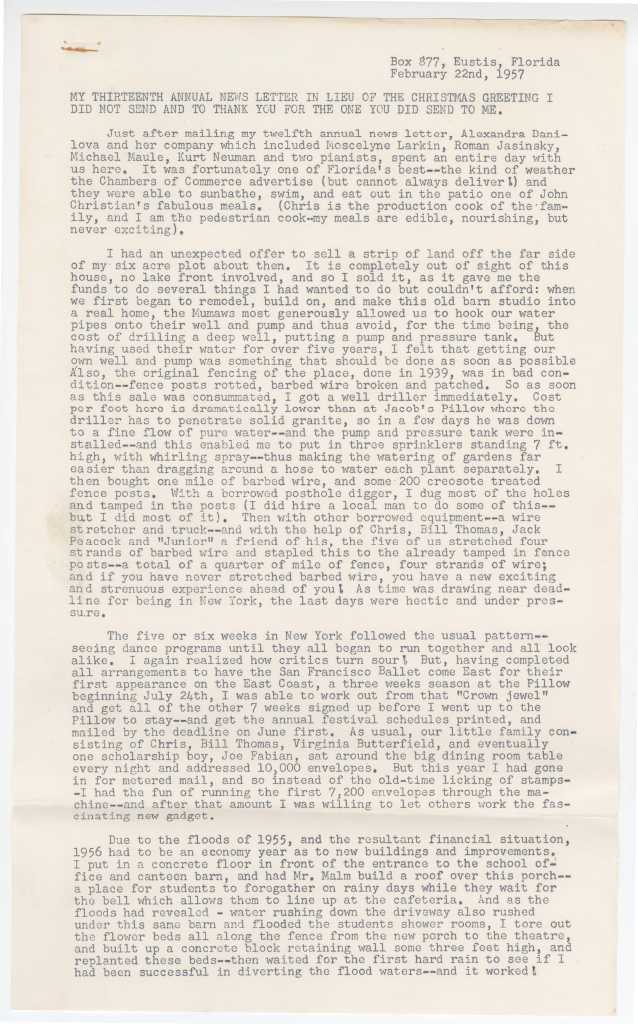
Neither Shawn nor Graham ever forgot their connections forged during the Denishawn era.Neither Shawn nor Graham ever forgot their connections forged during the Denishawn era. Shawn was eager to present the Martha Graham Dance Company at Jacob’s Pillow. In his 1957 newsletter to friends, audience members, and donors, he wrote:
“Martha Graham and Bethsabée de Rothschild came up to see a performance. This was Martha’s first visit to Jacob’s Pillow, to me it was a red letter day. For having been associated with this very great artist for 8 close years (starting in 1916 when she first studied with me at Denishawn in Los Angeles, producing her first professional vehicle for her (Xochitl) then having her in my own “solo” tour as partner, and in the Denishawn company 1922-1924, it has been my hope and dream for years that Martha and her company would come to Jacob’s Pillow to dance on our festival someday. Martha and Miss de Rothschild visited all the classes of the school, had a cafeteria lunch with us, and returned at night for the performance[…]”
Martha loved our theatre, and gave me real hope that someday she will grace the stage of the Ted Shawn Theatre.
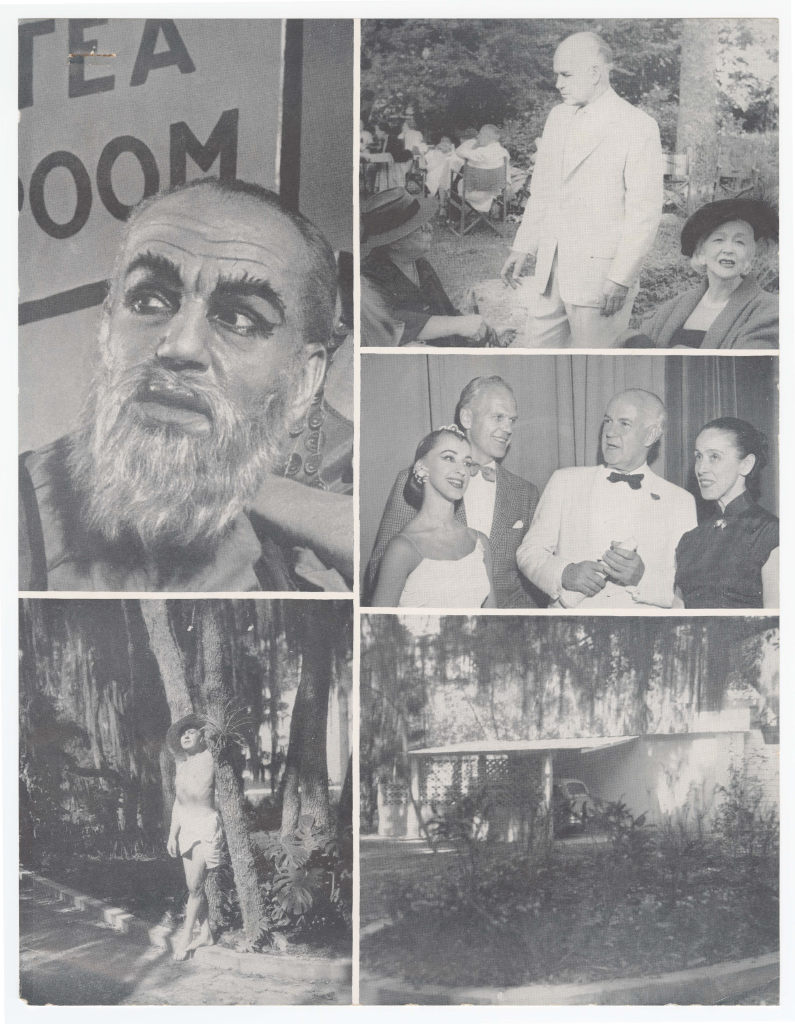
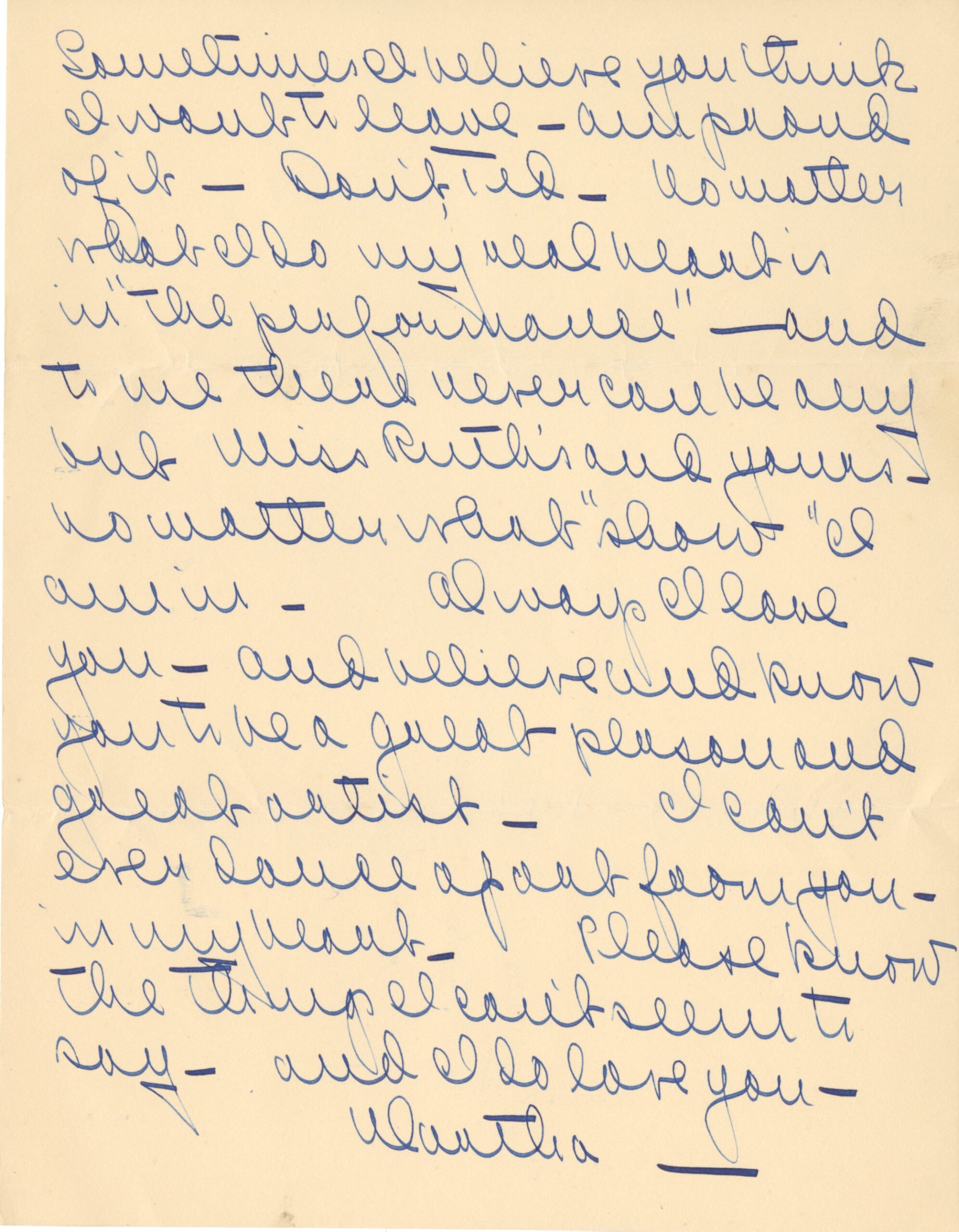
In an April 1923 letter to Shawn, Graham wrote: “The artist in me was born in Denishawn – and because that is fundamentally the me – I was born there.”
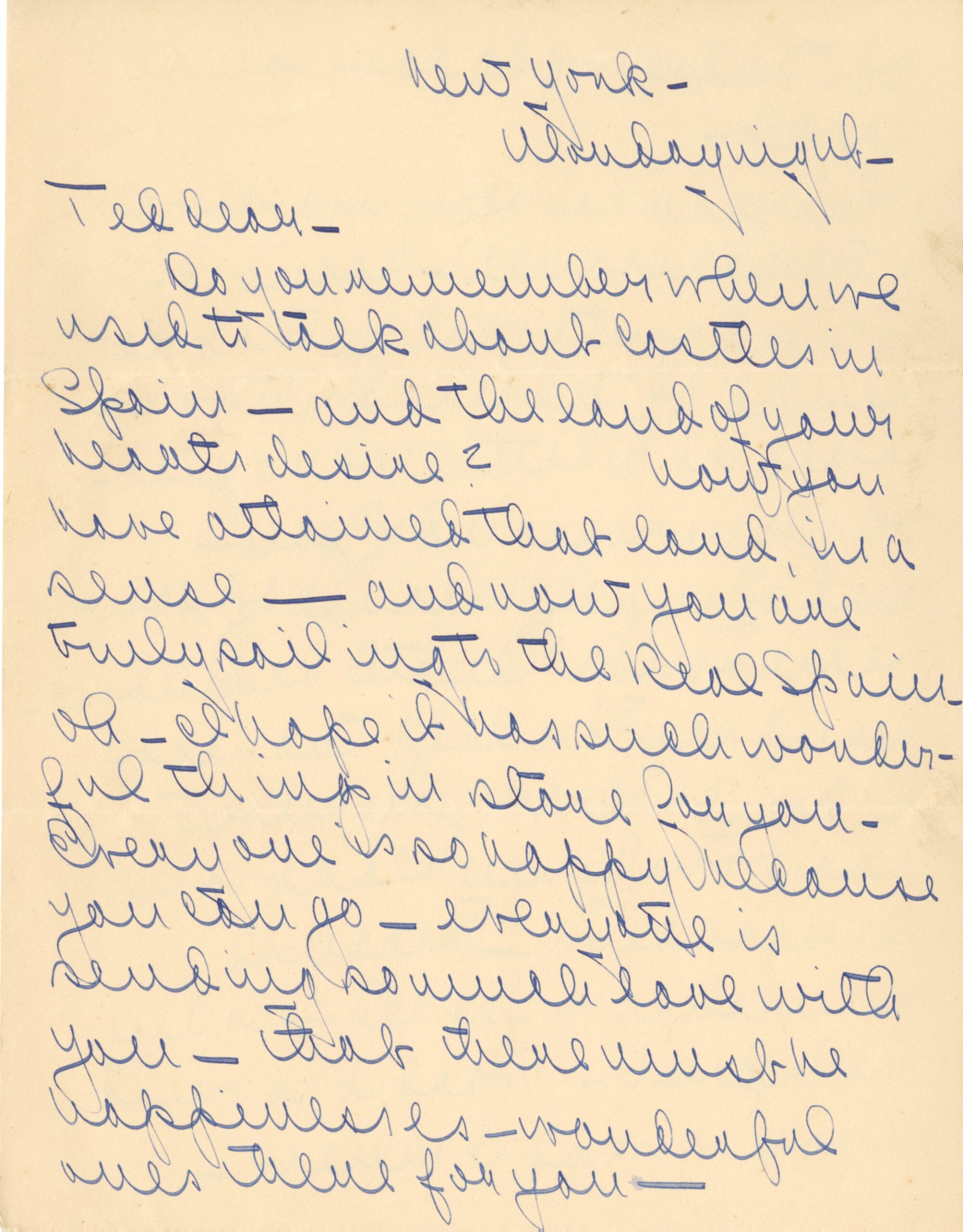
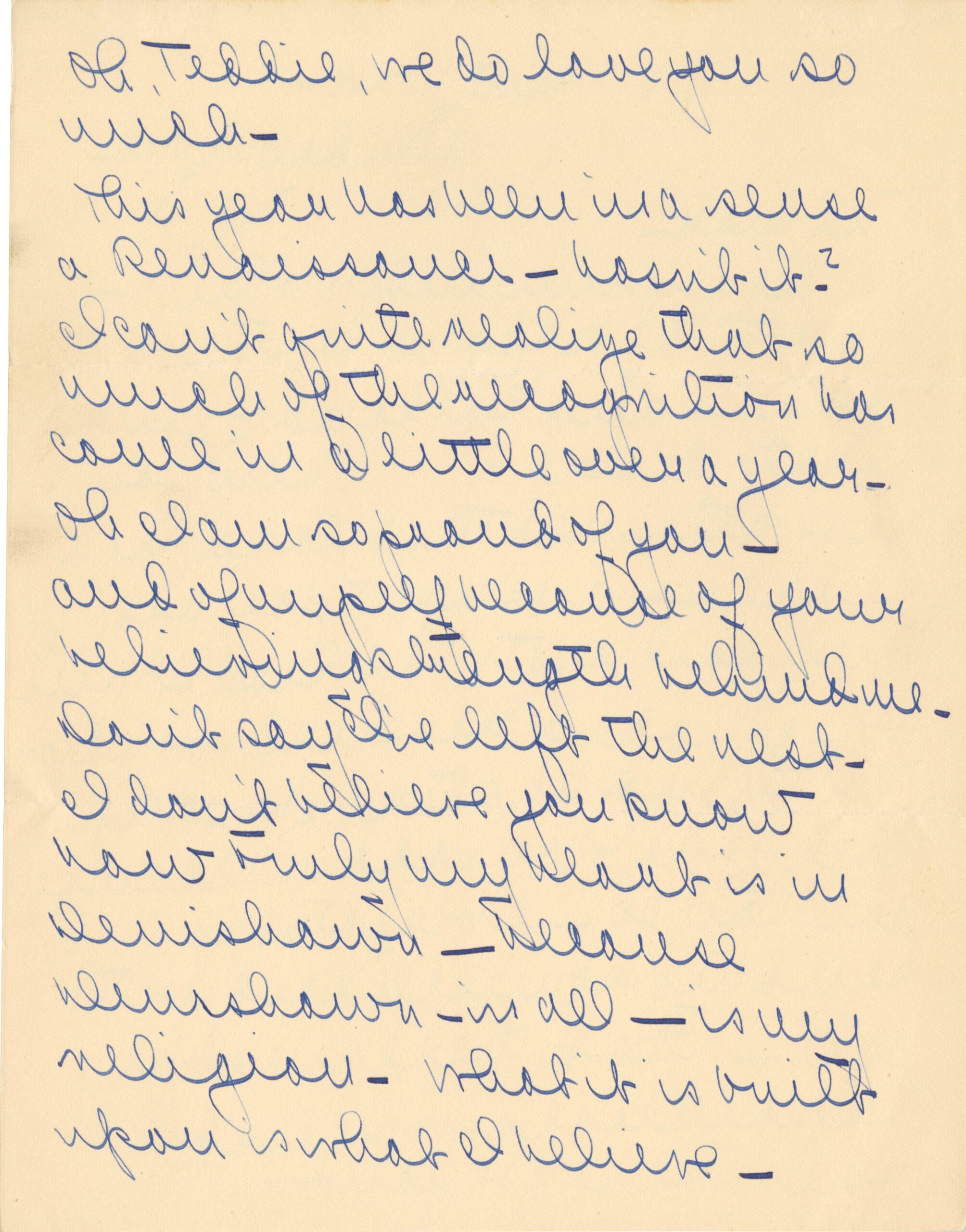
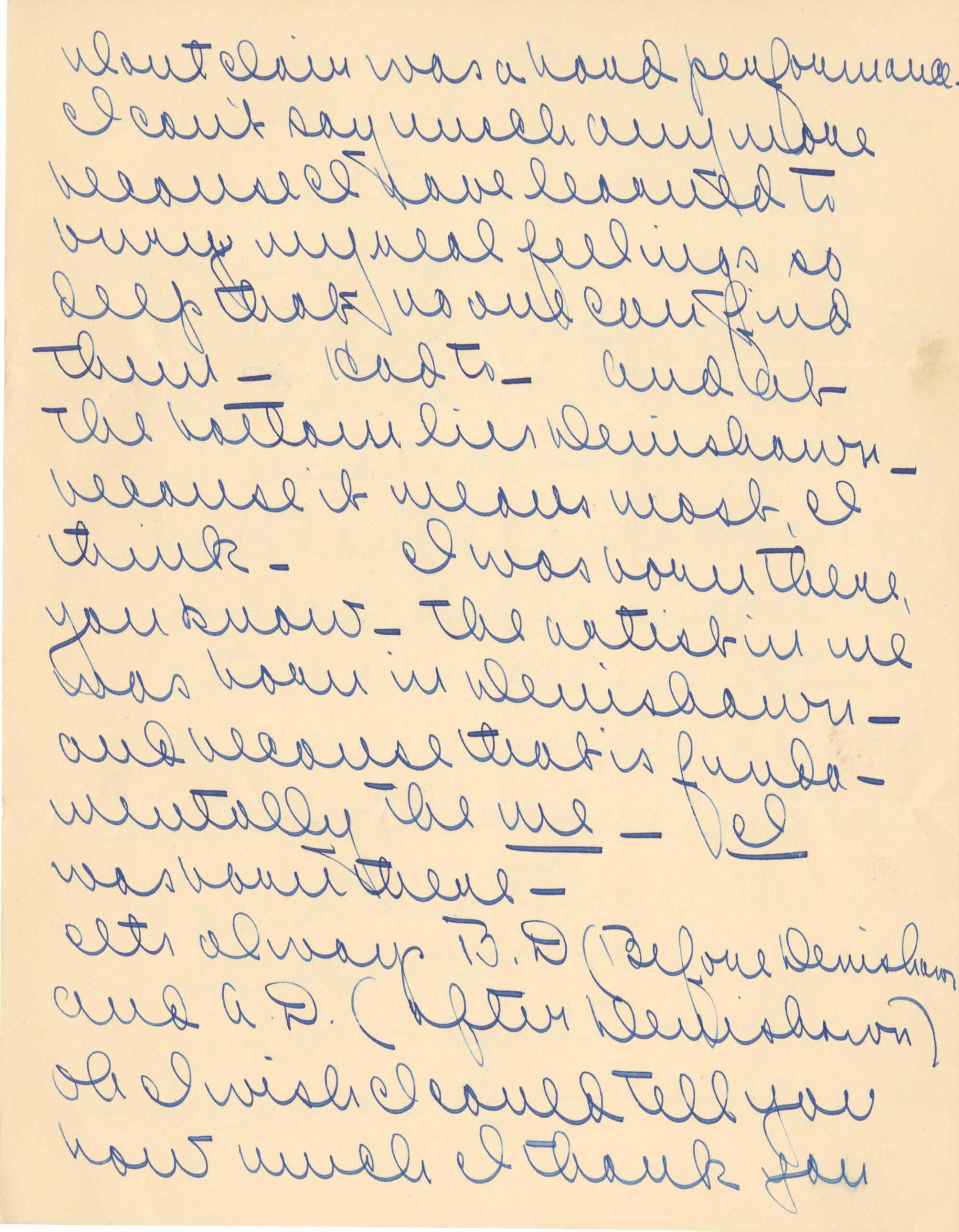
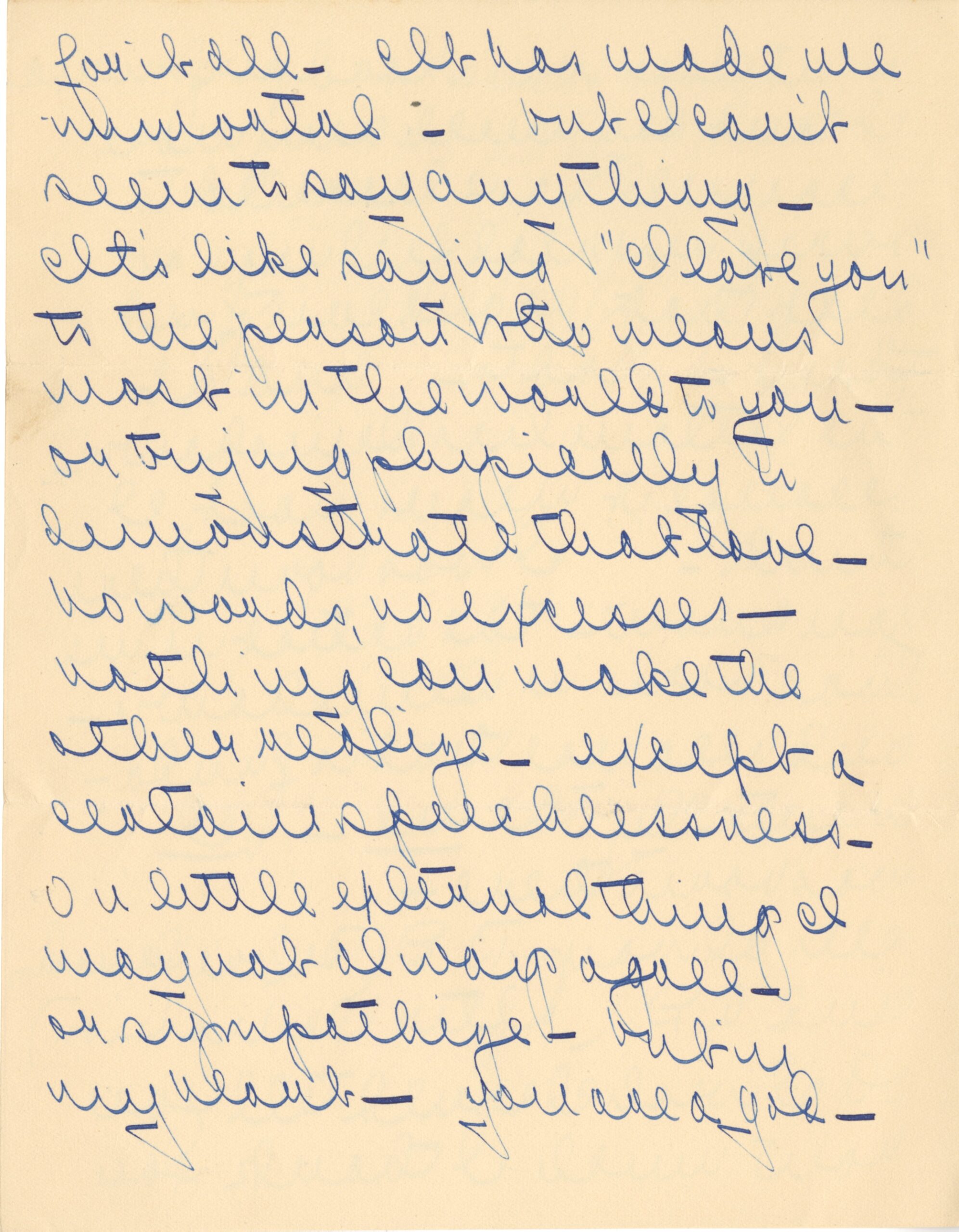
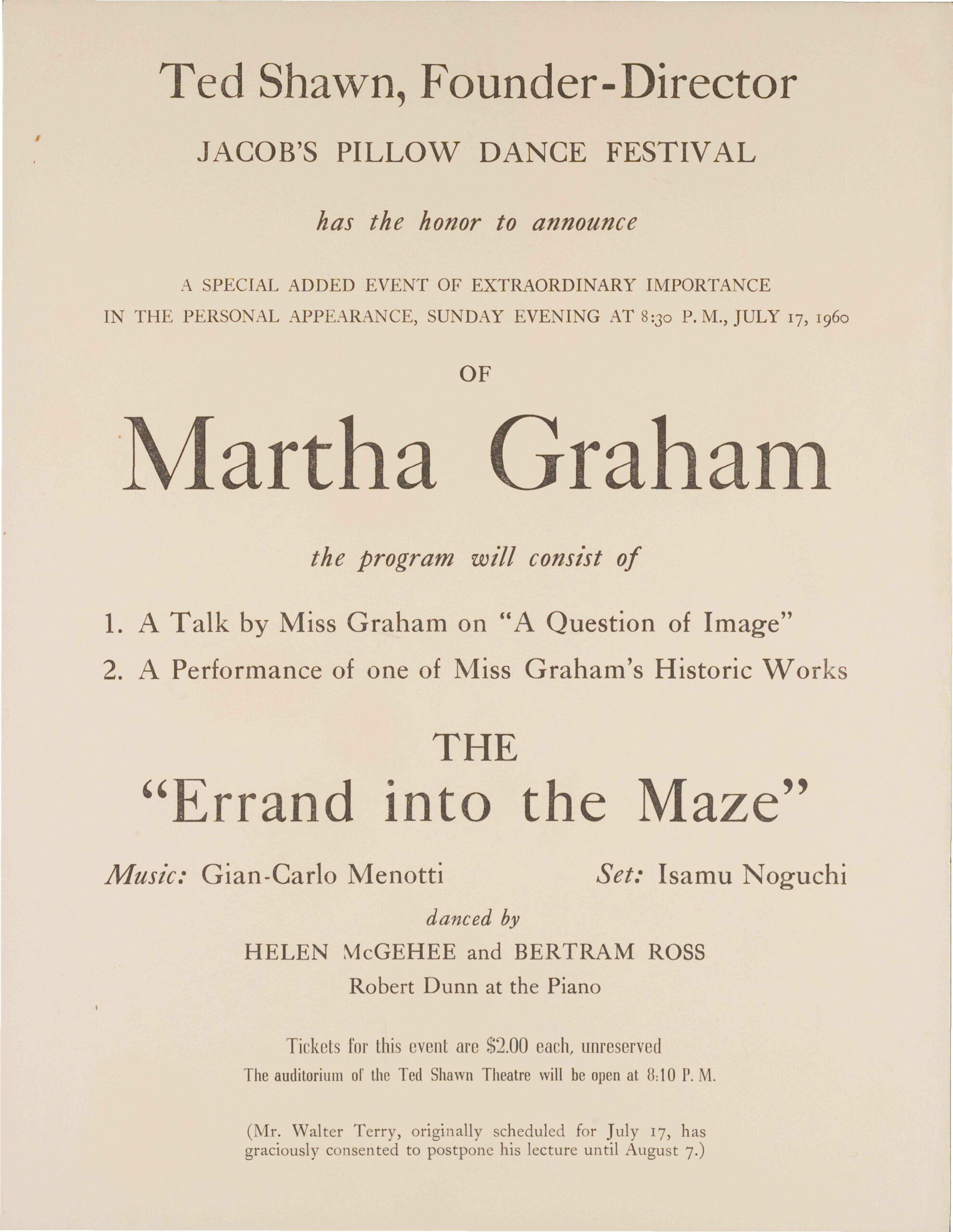
While Shawn’s dream of the company’s performance did not occur in his lifetime, he did prevail on Graham to present a lecture at the Pillow in 1960. Much was made of Graham’s first appearance. Publicity materials proclaimed, “Ted Shawn, Founder–Director Jacob’s Pillow Dance Festival has the honor to announce a special added event of extraordinary importance in the personal appearance of Martha Graham.” The evening included a lecture by Graham and a performance of the duet Errand into the Maze by Helen McGehee and Bertram Ross (1947).
Martha Graham Dance Company Onstage at the Pillow
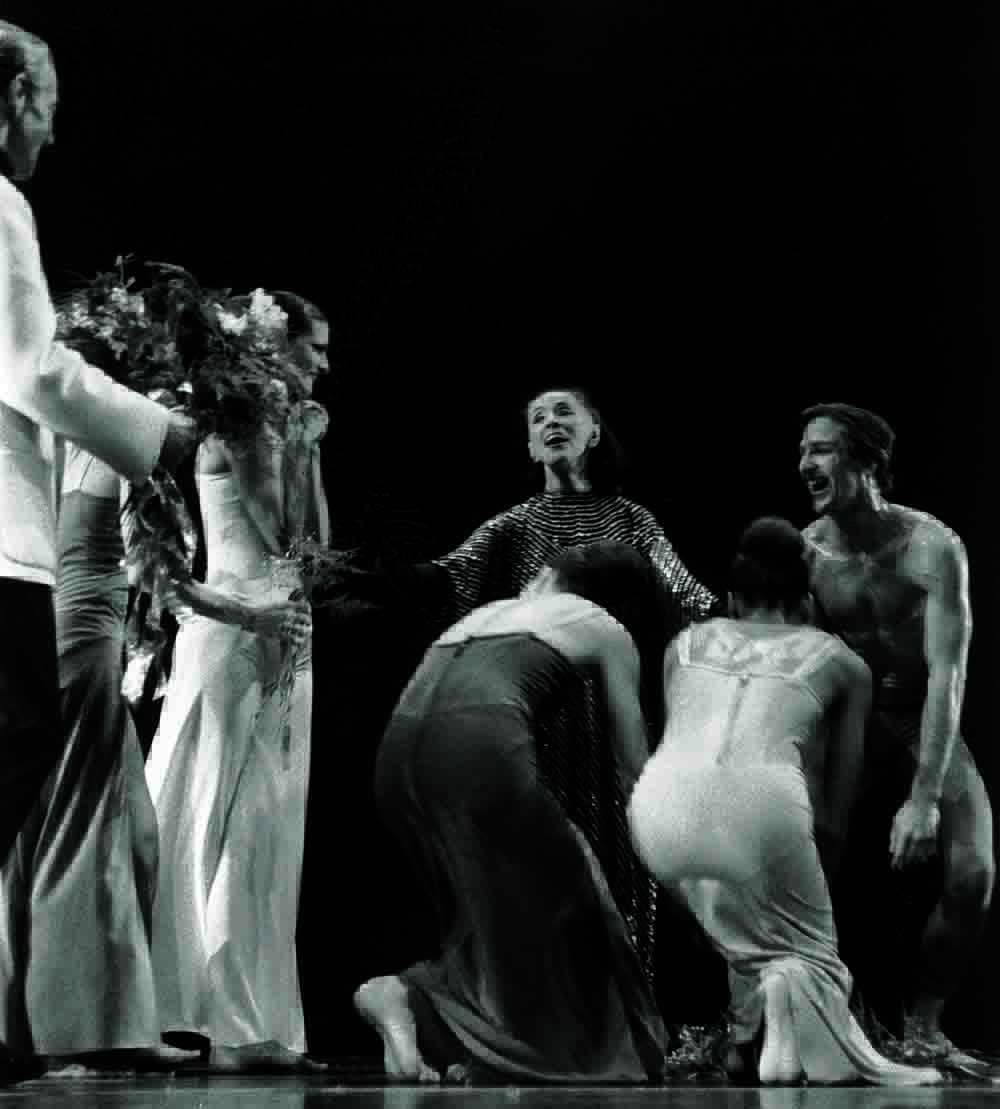
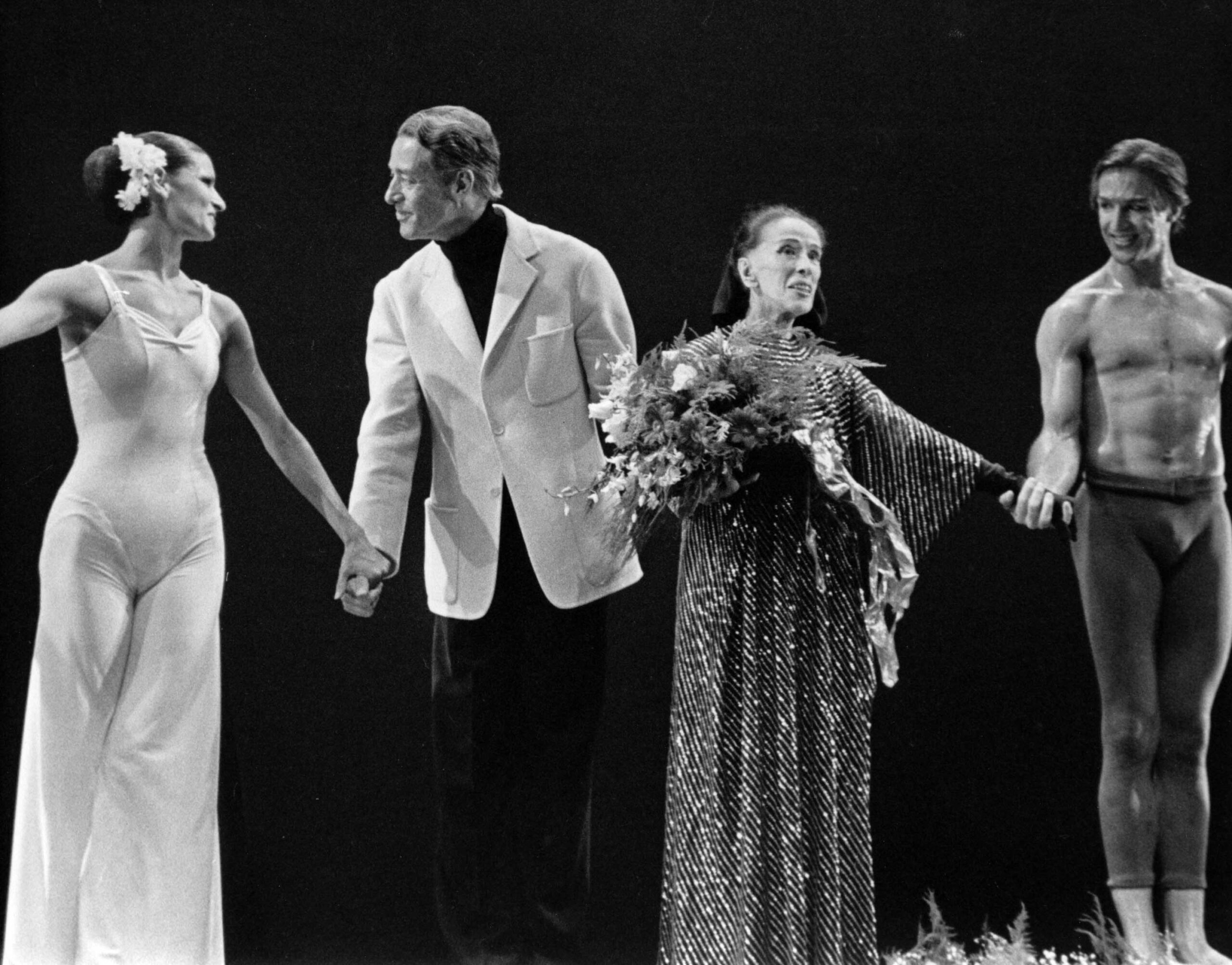
The company made its debut performance on the Ted Shawn Theatre stage in 1984. More than a decade after Shawn’s death, and nearly 50 years after the company’s founding, Graham finally accepted the invitation. The company danced three works, Cave of the Heart (1946), Errand into the Maze (1947) and Diversion of Angels (1948). It was a momentous occasion with a champagne toast that included the whole audience, led by then-Pillow director Liz Thompson.
As she said, with her glass held high, “Special Events 1984” Moving image 58 (Videographer/Filmmaker: Caro Thompson), Jacob’s Pillow Archives, 1984.
“I usually introduce myself as Liz Thompson, the Executive Director of Jacob’s Pillow. But tonight I’d like to introduce myself as Liz Thompson, former Graham student. I sweated, contracted and released in that studio for very many, many years. For me, it’s a personal pleasure to welcome this woman that I love very dearly who has been very important to me, my own personal life as well as in my career. And she has been one of the most important artists of this century. For the Pillow, it’s a moment in history that we have waited for a long, long time. This is the Martha Graham Company’s first appearance here.”
There are women in the dance world, like Martha Graham, who make us work very hard so that she can continue making art. I salute her.
Onstage that evening was former Pillow student Terese Capucilli, by now a principal with the company. Graham herself was there, bowing with the dancers, in a gown designed for her by Halston.
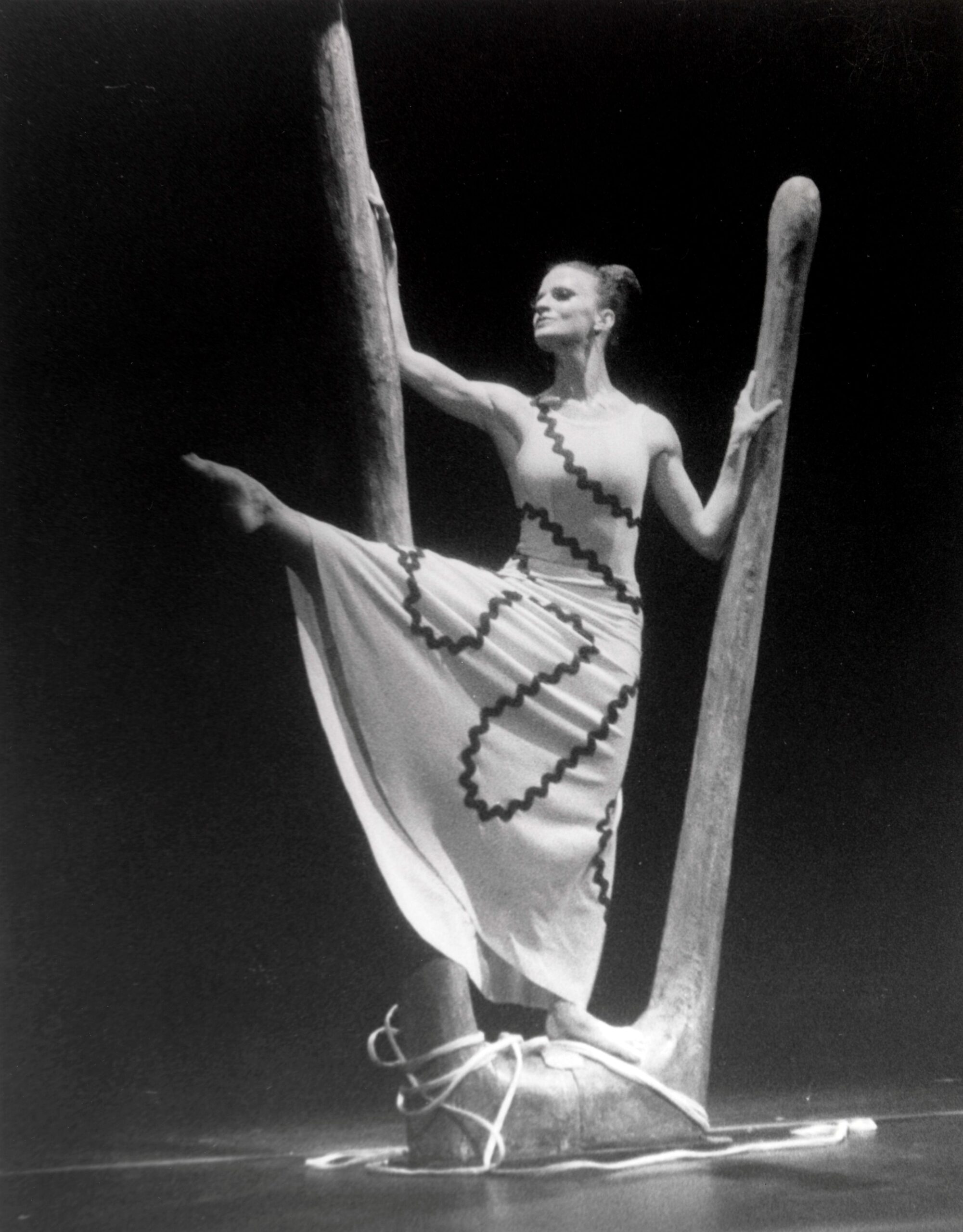
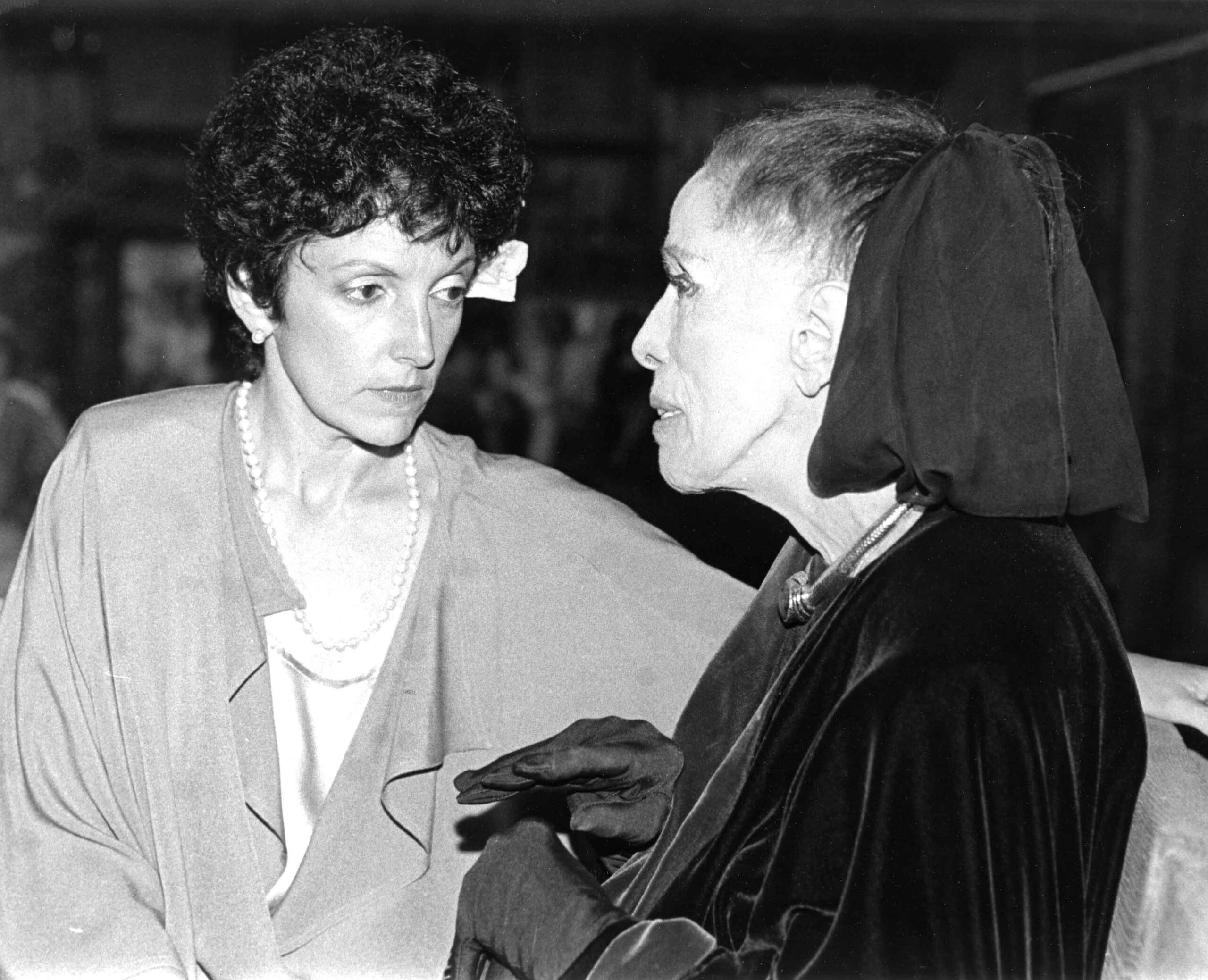
This began a new chapter in the relationship between the Martha Graham Dance Company and Jacob’s Pillow that endures today, with the company taking the stage as Shawn had long hoped. Beyond the duets danced by Shawn and Graham, beyond their personal and professional relationships. Graham stood in the theatre that Shawn built and did what she did best: working with the dancers to make her choreography come to life.
Graham died in the spring of 1991, and that profound loss to the Pillow and the dance world at large was acknowledged at the season opening Pillow Gala. Bessie Schönberg, choreographer and longtime choreography teacher at The School at Jacob’s Pillow, had worked with Graham and performed with her company from 1929 to 1931, when an injury ended her performing career and diverted her into teaching. Schönberg spoke about Graham’s life in dance, noting “her work and her life, her continuing contribution to the world of dance, she’s had no peer.”
Following Graham’s death, the Martha Graham Dance Company returned in 1994, ten years after the first performance and has performed six times since, with increasing frequency (2005, 2013, 2015, 2019, 2023, and now in 2026). Even with the late start of the collaboration between the company and Jacob’s Pillow, deep associations connect them, made evident by looking at the dances.
Lamentation at the Pillow: An Example
Only a few years after Graham left Denishawn, she made one of her signature works, the solo Lamentation (1930). It was uncharted territory for a choreographic exploration. In Lamentation, Graham stopped filling the stage with pretty steps and flashing skirts. She sat down on a plain square pedestal, wrapped in a cloth tube of her own design, and rocked and keened. With movement simultaneously so full and so spare and generated from a wellspring of emotion deep inside her torso, Graham proposed a new vision of what a woman could dance, both its subject matter and its motion.Graham proposed a new vision of what a woman could dance, both its subject matter and its motion.
That signature work of Graham’s remains utterly new and ever present. It serves as an example of how the company is enmeshed in Pillow in numerous ways, by both the company and other artists contemplating the masterwork. The most recent example is Lamentation: Dancing the Archive (2025) by Graham dancer Xin Ying. (Co-creators: Katherine Helen Fisher and Alan Winslow), a featured artist in the inaugural exhibit at the Doris Duke Theatre, Dancing the Algorithm. In a PillowTalk about human and computer interactions, Norton Owen asked Xin about using technology not to look at the future, but to the past with Graham’s Lamentation. “PillowTalk: Katherine Helen Fisher, Lauren Bedal, and Xin Ying – moderated by Norton Owen.” Moving image 7986 (Videographer/Filmmaker Solana Armatage),), Jacob’s Pillow Archives, July 5, 2025.
Xin replied, “They very naturally go together. That’s the world of the artist, a responsibility almost. You live in the present, and you’re always connecting what is going on in the future with the past[…] Technology can be material, technology can be a future, like a condition we’re living in, technology can be a gateway. This is all the ways I’m thinking about, how to engage with the past.”
Like Graham says in Blood Memory, we live in the present to discover the past. That’s how I feel."
Former company member Peggy Lyman and Artistic Director Janet Eilber were the second generation of Graham dancers who took on Graham’s own roles. They worked with Graham to reconstruct the iconic solo in 1973. No one had seen the work since Graham herself had performed it in the early 1930s. In “Rediscovering Martha Graham,” (PillowTalk, 2005) with Eilber and Lyman, Lyman said that she learned something in that process that became so important to her. “Martha was the first person to make changes to fit the individual dancer’s body and way of expressing physical movement.” When asked to expand on why that was so critical, Lyman said, “The important thing is that work says what it’s supposed to say, not the dancers doing exactly the same movement.”“PillowTalk: Rediscovering Martha Graham” Moving image 2679 (Videographer/Filmmaker Eva Barnett), Jacob’s Pillow Archives, July 2, 2005.
Eilber agreed, adding, “And being the brilliant director that she was, she wanted us to pull out our own experience, our own dynamics, our own emotions, and fill the character with ourselves.” Eilber explained that the Lamentation reconstruction was possible because of an early film of Graham dancing. It had been filmed on what was then “experimental new color film technology from Eastman Kodak.”“PillowTalk: Rediscovering Martha Graham” Moving image 2679 (Videographer/Filmmaker Eva Barnett), Jacob’s Pillow Archives, July 2, 2005.
When asked what made the tremendous shift in artistic perspective between the Denishawn-derivative works to Lamentation in just a few short years, Eilber replied,“PillowTalk: Rediscovering Martha Graham” Moving image 2679 (Videographer/Filmmaker Eva Barnett), Jacob’s Pillow Archives, July 2, 2005.PillowTalk: Rediscovering Martha Graham” Moving image 2679 (Videographer/Filmmaker Eva Barnett), Jacob’s Pillow Archives, July 2, 2005.
I think this is an instance of the right genius being in the right spot at the right time. America was on a collision course with this new art form and Martha was there to take it all and turn it into what she turned it into. And it took a genius, but the stars were aligned[…] This idea of getting down to the essence of communication was happening in music, it was happening in architecture, it was happening in the visual arts and photography."
While 2005 was the company’s first Pillow performance of Lamentation, a version of it had been danced three years earlier by Richard Move in Martha@ThePillow. Move’s first performance of Graham was one night in a series of drag impersonations in a tiny club in the meatpacking district of New York before becoming an evening-length production. Like many drag performances, Move’s portrayal of Graham is at once highly camp and deeply respectful. Studying her mannerisms and performing them with such care is not merely a thoroughly professional performance by Move, it also pays homage to the tremendous impact Graham had on the dance world.
The 2002 performance concludes with Move dancing Lamentation. Unlike Graham, Move is bare-chested. Move said in the post-show talk,“Martha @ the Pillow: Post-Show Talk.” Moving image 1879, Jacob’s Pillow Archives, August 9, 2002.
I wanted to at the appropriate moment, which is for me the end of the performance, break that artifice and reveal some more of myself. I think it’s very appropriate for Lamentation because I think the bare chested-ness has more of a vulnerable feeling to it. [Graham] of course, wasn’t[…] so it’s about breaking the artifice of the show and the vulnerability of the flesh."
Move went on to be one of the artists commissioned for what the company describes as an ongoing creative project, Lamentation Variations. Choreographers are invited to create short dances for the company inspired by the early film of Graham’s performance. The choreographers can cast as many or as few dancers as they choose for the variation and are required to follow four conditions:
- Make a dance under 4 minutes long (the length of Lamentation)
- Use only 10 hours of rehearsal with the dancers
- Choose public domain music, silence, or other rights-free music
- Use basic costumes and simple lighting design.
Artistic Director Eilber has commissioned more than just Lamentation Variations for the company. In “Framing Graham” a PillowTalk in 2013, Pillow Scholar in Residence Suzanne Carbonneau asked, “Why do you think it’s necessary or desirable to commission works from new choreographers instead of it just being the Martha Graham Dance Company doing her work?” Eilber said,“PillowTalk: Framing Martha Graham” Moving image 5085 (Videographer/Filmmaker Kendra Brisco), Jacob’s Pillow Archives, August 24, 2013.
Because it resonates on her work. It’s a two way street. It’s not only honoring her sense of innovation and her avidity for the new, or appetite for the new, as she used to say[...] It expands our dancers; it expands what we offer on a program. And we see the Graham works in the context of these new works, and we see the new works in the context of the Graham works. It’s a one plus one makes three. There’s really an extra resonance that we’re going for."
Two Pillow seasons have included Lamentation Variations in Martha Graham Dance Company appearances, in 2013 and 2019, including choreographers well-known to Pillow audiences such as Michelle Dorrance, Aszure Barton, Liz Gerring, and Richard Move. In addition, the company has danced works by Mats Ek (AXE, 2015), Hofesh Shechter (CAVE, 2022), Nacho Duato (Rust, 2013), among others, in their Pillow appearances.
While Lamentation has appeared on stage and screen and been much discussed, the next example shows a different kind of collaboration between the company and Jacob’s Pillow.
Graham’s Rite of Spring: Graham in The School at Jacob’s Pillow
In 1999, Terese Capucilli, in her 20th year in the company and then Associate Artistic Director, taught in the School at Jacob’s Pillow. Capucilli had been a student in the School herself prior to performing in the company’s debut performance. Known for her interpretation of roles originally danced by Graham, for this residency Capucilli taught a role that Graham had made for her: The Chosen One, from Graham’s Rite of Spring (1984) to Pillow School participants. In this clip, Capucilli coaches the dancers on the solo.
Fourteen years after the dancers in the School performed an excerpt of Rite of Spring on the outdoor stage, the company danced the full work in the Ted Shawn Theatre. This is another example of how Graham’s legacy is stitched into the fabric of the Pillow. See excerpt of Rite of Spring.
Conclusion
In a PillowTalk titled “Martha Graham Forever,” a part of Richard Move’s 2005 Martha@ThePillow engagement, Pillow scholar Philip Szporer asked Graham dancer Stuart Hodes, “What do you think were her greatest qualities?” Hodes had been a Graham company member for more than a decade and a frequent partner of Graham’s. Hodes replied,
“Martha’s greatest quality? Well, I think her vision, I mean where it led her and her greatest quality was also her greatest fault. She couldn’t see out of her vision, everything was a part of it. All of her dancers, all of the people she worked with, in a sense served what she wanted to do…
I think the greatest thing about her was this genius. It drew me; I couldn’t escape that. I wanted to be there[…]”
It’s wonderful to be around somebody whose mind is so electric and who sees things very differently from the way I see them[...] She makes her dances that way and she conducts the company that way. You felt like you could see a little further than you could see.
Martha Graham, for all you did in your lifetime in the arts, for all that your dances and dancers do for the world today, and your continuing electric genius at Jacob’s Pillow and beyond, here’s to at least 100 more years. Thank you.
Additional Online Resources
Performance Excerpts
Martha Graham Dance Company Night Journey (1994)
Wendy Whelan & Lloyd Knight “Moon” from Canticle for Innocent Comedians (2013)
Martha Graham Dance Company “Prelude to Action” from Chronicle (2019)
Martha @ The Pillow Debate 2002 / Three Seascapes
Talks
Post-Show Talk: Martha Graham Dance Company (2015)
Post-Show Talk: Martha Graham Dance Company (2013)
Post-Show Talk: Martha Graham Dance Company (2019)
Post- Show Talk: Martha Graham Dance Company (2023)
PillowTalk: When Dance Became Modern (2023)
PillowVoices Podcast Episodes
The Dancing Body: Graham After Graham
Published July 2026
Postscript
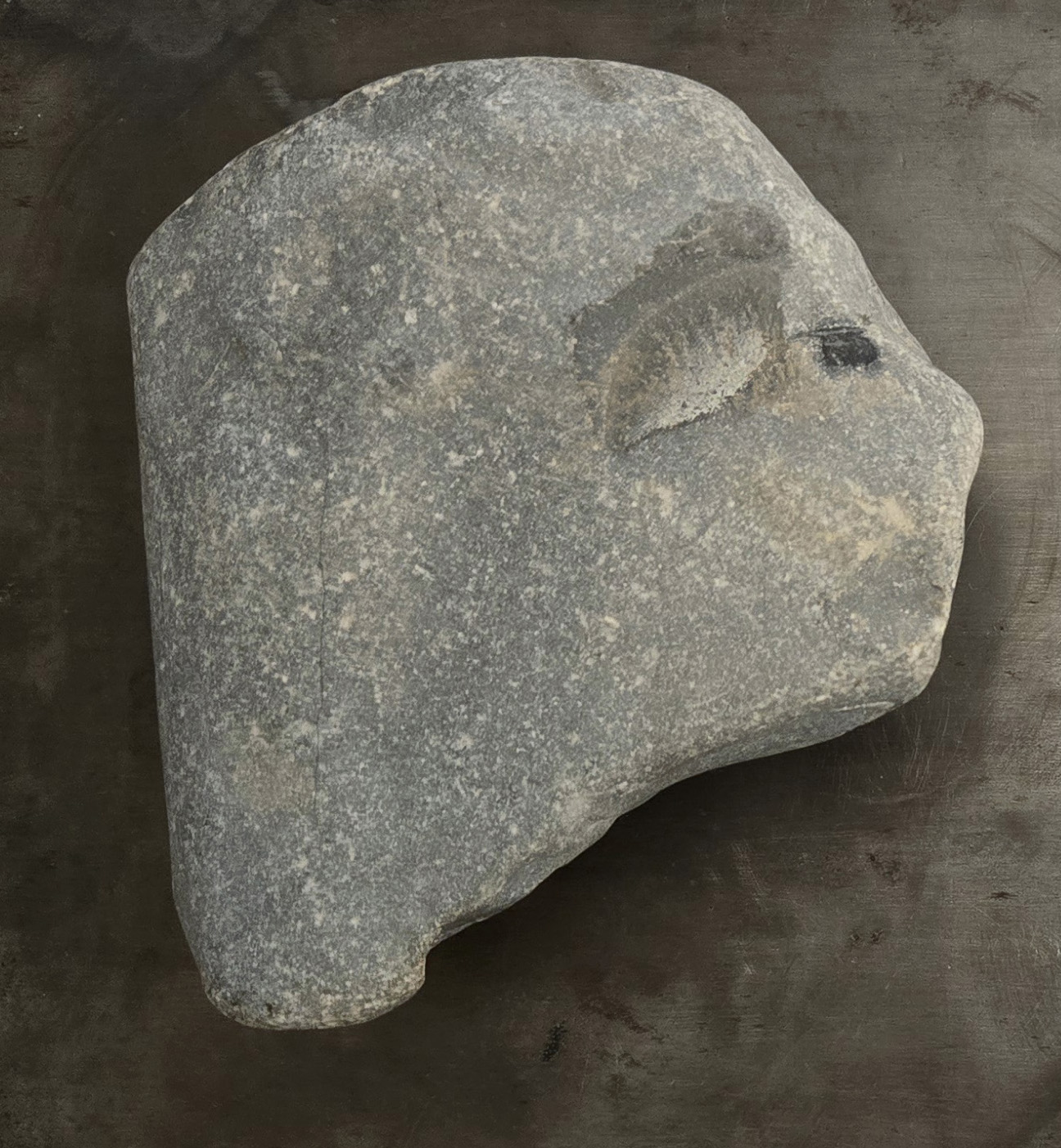
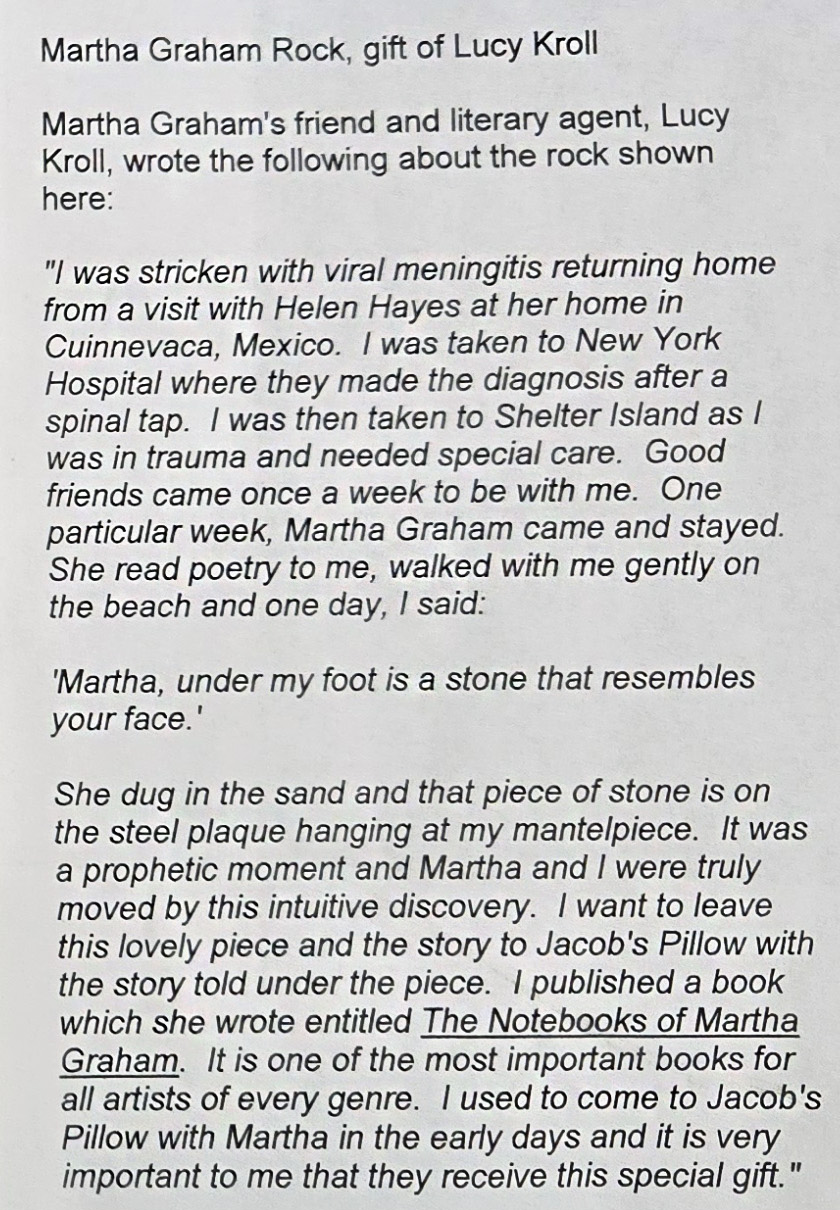
Among the many photographs, videos, programs, and other Graham-related materials in the Jacob’s Pillow Archives, one item stands out as especially unusual and completely unique. The literary agent Lucy Kroll (1909-1997) worked with many famous personalities during her lifetime, including Carl Sandburg, James Earl Jones, Norman Mailer, and Horton Foote. She owned a home in the Berkshires, where she prominently displayed a treasured memento of her friendship with Martha Graham. She directed that this artifact be preserved in the Jacob’s Pillow Archives after her death, and it’s displayed here along with the story of its significance.