
Founding Her Company
Pam Tanowitz founded her company in 2000, and has received critical and popular acclaim for the exquisite dancing, formalist choreography, and commitment to the relationship between music and dance. As New York Times dance critic Gia Kourlas commented,
Tanowitz’s approach is simple on the surface: she makes steps to music.”
Making steps to music may sound easy, but as anyone who has seen the work of Twyla Tharp or Mark Morris knows, the seemingly effortless relationship between sound and movement takes sophistication, subtlety, and skill. Further, a choreographer with a passion for and understanding of complex music can make a complicated and potentially alienating sound score comprehensible.
Dance and Music
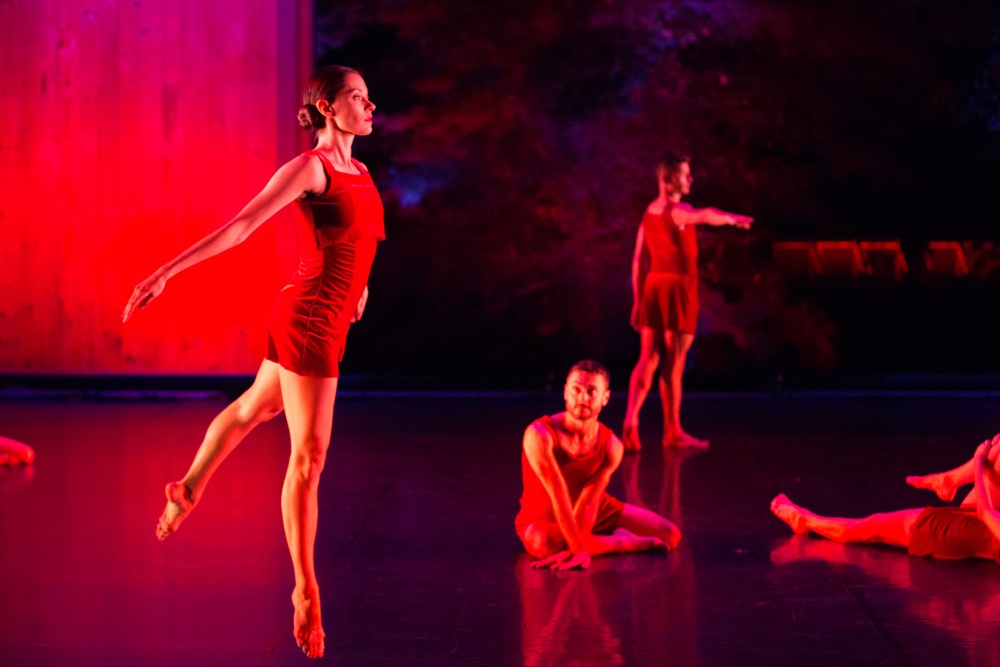
Tanowitz is drawn to music of all sorts—from the classical, such as Franz Liszt and Franz Schubert, to the popular, such as Cheap Trick. She also finds great inspiration in music by contemporary classical and avant-garde composers such as John Zorn, Charles Wuorinen, and Henry Cowell. In her 2016 Pillow season, The FLUX Quartet performed on stage with Pam Tanowitz Dance for two works. The first was Heaven on One’s Head, danced to Conlon Nancarrow’s “String Quartets Nos. 1 and 3”. The second work, titled the story progresses as if in a dream of glittering surfaces, is danced to two pieces of music; the first is “Four Marys” by Julia Wolfe and the second is an original score by Dan Siegler.
Importance of Dance’s History
Choreographic form and the dancers’ exquisite execution couples with Tanowitz’s dedication to dance history. She is less concerned with movement invention than understanding the history of movements. New Yorker writer Andrew Boynton points to “the steps and placement of ballet,” and “the wit and risk of [Merce] Cunningham.” New York Times critic Gia Kourlas calls attention to her “deeply rigorous excavations of ballet and classic modern dance vocabulary,” while fellow Times critic Alastair Macaulay says her work is “closer to barefoot ballet than modern dance,” and finally a third Times critic Brian Seibert notes her as a “deconstructionist of ballet and modern dance.”Boynton, The New Yorker, June 7, 2013; Kourlas, New York Times, May 10, 2013; Macaulay, New York Times February 19, 2016; Seibert, New York Times, May 16, 2013
Tanowitz was awarded the 2016 Juried Bessie Award—a New York Dance and Performance Award. The committee noted: “For using form and structure as a vehicle for challenging audiences to think, to feel, to experience movement; for pursuing her uniquely poetic and theatrical vision with astounding rigor and focus, [this award] goes to Pam Tanowitz.”
Pam Tanowitz Dance also performed on Inside/Out in 2002, 2005, and 2009.
Melissa Toogood serves as rehearsal director for Pam Tanowitz Dance. Toogood has her own history with the Pillow, starting as a student in The School at Jacob’s Pillow, and returning as a member of Merce Cunningham Dance Company. (To see Toogood in additional works, visit the Archives to see her as a Contemporary Traditions student on Inside/Out, performing with the Merce Cunningham Dance Company, in the PillowTalk Dancing for Cunningham, and teaching a master class during the Pam Tanowitz Dance residency.)
PUBLISHED March 2017