
Introduction
Queerness, a reclaimed term that assumed its current usage in the 1990s, has long been embodied by women and lesbians at Jacob’s Pillow. Several have been previously featured on this platform: Meredith Monk, whose shape-shifting performances defied singular identity in both body and voice; Elizabeth Streb, whose relentless and extreme physicality refused to be the kind of dance that disappeared in the mind of the viewer; Ann Carlson, who exposed transitions and process while engaging casually with audiences; and Chandralekha, whose contemporary Bharatanatyam works radiated erotic power. Together, they offer a complex and embodied portrait of queer and lesbian choreography in the late twentieth century. However, other lesbian artists who graced the stages at the Pillow deserve recognition, as their contributions deepen our understanding of the legacy of queer women and femmes in dance today.
Cultural Context
During the 1980s and 1990s, under the weight of the AIDS crisis, queer communities faced intense homophobia and loss. Gay men were disproportionately impacted by the virus and thus hypervisible and stigmatized, but during this time, they made huge choreographic strides, changing the trajectory of contemporary dance. Some of the most well-known choreographers in late 20th century contemporary concert dance are gay men: Alvin Ailey, Merce Cunningham, Lar Lubovitch, Mark Morris, Paul Taylor, Bill T. Jones and Arnie Zane.
Artmaking in the 1990s was also marred by the National Endowment for the Arts’ (NEA) decision not to fund projects deemed “obscene,” including works involving sadomasochism, homoeroticism, or explicit sex acts. This policy discouraged many artists from applying for NEA funding and further marginalized projects that overtly explored homosexuality.
The intensification of homophobia and policing of sexual expression in arts funding, coupled with the prominence of gay men in public discourse due to the AIDS crisis, compounded the challenges lesbians faced in gaining cultural prominence and visibility in the dance field. Still, they made remarkable contributions to concert dance that resonate through the current work of women, queer artists, and lesbian choreographers.
Polly Motley
In 1994, Jacob’s Pillow presented Polly Motley’s Stand by Your Man and Folk Dance. A Texas native living in Colorado at the time, Motley collaborated with her partner, video artist Molly Davies, to create intimate multimedia performances. Using tightly-framed instant-replay and video projections, Motley moves between familial relationships, social mores, gender expression, and overlapping temporalities.
Created in 1990, Stand by Your Man draws on Motley’s father as source material. She regards his comments about her—beautiful, smart as a whip—as well as his morning routines and bouts of intoxication, with a poignant blend of admiration and revulsion. The work frames Polly Motley’s body as a continuously shifting entity, projected across three brightly glowing television screens on rolling carts. The performance relies on live camera feeds, with videographers Molly Davies and Peter Strietmann capturing and transmitting close-up images to screens positioned throughout the space. Throughout, the videographers and their equipment remain plainly visible to the audience as Motley slips between self, father, narrative, and archetype.
Close-up framing heightens the ambiguity of her state—whether dressing or undressing—producing an effect that suggests vulnerability and sensuality. At other moments, she appears fully dressed in a man’s suit, moving with a deliberately upright sense of propriety. The larger-than-life scale of the screen images renders Motley’s live presence comparatively small and indistinct, further disorienting the relationship between the live body and its mediated representation. As the performance progresses, multiple images are revealed simultaneously, layering, disrupting, and contradicting one another, creating a fragmented experience for the viewer.
This fragmented experience may reflect the artist’s queer aesthetics. Sara Ahmed, in Queer Phenomenology, encourages us to seek fleeting moments of misalignment—those that disrupt linear expectations. Motley’s performance evokes such disorientation: intimacies seem at once familial and sexual, gendered images collide and interrupt one another, and an uncannily slow tempo feels at odds with the image of Motley curling into a ball, extending her palm as if to say “Do not come any closer.”
Although no one touches during the performance, the projected images feel tactile, sensuous, even desirous. A charged tension exists between the camera and the body—close yet never touching—suggesting an erotic energy that is itself destabilized by the limitations of the medium. The trio of the performance, involving Motley and her two videographers, only one of whom is her romantic partner, creates a closeness in which Motley’s body is revealed and visible yet remains just out of reach. Ahmed’s reminder to “inhabit the intensity of [the queer moment],” rather than resolve or “overcome” its disorientationAhmed, Sara. Queer Phenomenology: Orientations, Objects, Others (2006): 107. feels fitting as I watch Stand by Your Man thirty years after its live performance.
Paula Josa-Jones
In 1995, the Pillow presented Wonderland by Boston-based choreographer Paula Josa-Jones. A counter to the pared-down postmodern aesthetic of recent decades, and aligned with dance theatre, Wonderland embraced abundance, while delving into a more brutal and ominous aesthetic. Jones herself described the dance as a collision between Alice in Wonderland and the 1982 science fiction film Blade Runner.
Fittingly, both Alice in Wonderland and Blade Runner have been interpreted as queer-coded allegories.See Robert Yeates. “Urban Decay and Sexual Outlaws in the Blade Runner Universe.” Science Fiction Studies 44, no. 1 (2017): 65–83. https://doi.org/10.5621/sciefictstud.44.1.0065 and Frenzel, Friederike. “A “Fabulous Monster” and a “Wonderful Boy:” Gender and the Elusive Victorian Child in the Alice Books and Peter Pan” Open Cultural Studies 5, no. 1 (2021): 312-323. https://doi.org/10.1515/culture-2020-0141 In the former, Alice in Wonderland presents a threatening, “mad,” and incoherent dreamworld, starkly opposed to the domestic spaces to which girls were traditionally relegated. Alice’s constant bodily transformations enable her to experience her body anew at every turn. In the latter, the human-passing AI replicants in Blade Runner are labeled as morally deviant, and the film’s fixation on policing and “retiring” them parallels the broader societal policing of sexual expression during the AIDS crisis—a crisis dismissed as a gay issue by mainstream American culture well into the 1990s and beyond.
Josa-Jones’s Wonderland revels in theatrical excess and surrealism, crafting a world governed by enigmatic, unspoken rules. The corroded circus tent of a set functions both as a portal and a boundary, firmly locating Wonderland outside the realm of mainstream culture. In the opening section, dancers appear to be flung onto the stage by a malevolent force, attempting to adapt to the harsh weather of Deirdre Broderick’s soundscore.
The choreography darts between rigid, mechanical gestures and fleeting human vulnerability, creating a fractured world where dancers lurch on hyperextended legs, collapse into grotesque forms, and erupt into guttural screams. The stage grows cluttered with tricycles, broken umbrellas, distorted thrones, and prosthetic steel breasts, while the soundscore oscillates between spoken text (some unintelligible), lullabies, distorted heartbeats, and apocalyptic echoes.
In her book Queer Dance, Clare Croft asserts that queerness is made of “the pleasures and difficulties of moving between multiple, layered identities….No single entity marks something as queer dance, but rather it is how these textures press on the world and against one another that opens the possibility for a dance to be queer.”Croft, Clare. Queer Dance (2017): 1. In Wonderland, queerness emerges in the relationship between images, performers, and affects.
Throughout Wonderland, there seems to be a deliberate resistance to coherent logic. The performers are both restrained and chaotic, childlike and jaded. In this desolate, unsettling landscape, brief glimpses of humanity—a softening of the fingertips, a concerned glance—are quickly subsumed by the physical demands of the choreography, a task that feels unusually high-stakes, as if failing to complete it would be catastrophic.
In a talkback following her company’s performance on the Inside/Out stage, an audience member asks Josa-Jones what training is needed to create a work like Wonderland. She replies, “I just have a lot of audacity.”
What Counts as Queer?
Queerness is often transmitted covertly. This has everything to do with the fact that leaving too much of a trace has often meant that the queer subject has left herself open for attack. Instead of being clearly available as visible evidence, queerness has instead existed as innuendo, gossip, fleeting moments, and performances that are meant to be interacted with by those within its epistemological sphere—while evaporating at the touch of those who would eliminate queer possibility.
Lucinda Childs, renowned for her meticulously designed, repetitive explorations of limited movement vocabulary, has maintained a notoriously private personal life. Yet, she was romantically linked to two of the twentieth century’s most influential queer thinkers: Village Voice critic and journalist Jill Johnston and intellectual luminary Susan Sontag, who called for “an erotics of art” in her essay “Against Interpretation,” an influential text for Childs.
While often described as minimalist, Childs’ restraint and devotion to abstraction, at times, seem to obscure or repress a vibrant eroticism. At other times, her complex choreography, set to a steady musical pulse, builds to a structural climax that is both formally thrilling and deeply sensual.
Childs gained prominence in the mid-1960s with the Judson Dance Theater and later taught at Jacob’s Pillow in the 1980s. Her collaboration with Mikhail Baryshnikov’s White Oak Dance Project was showcased at the Pillow in 2002.
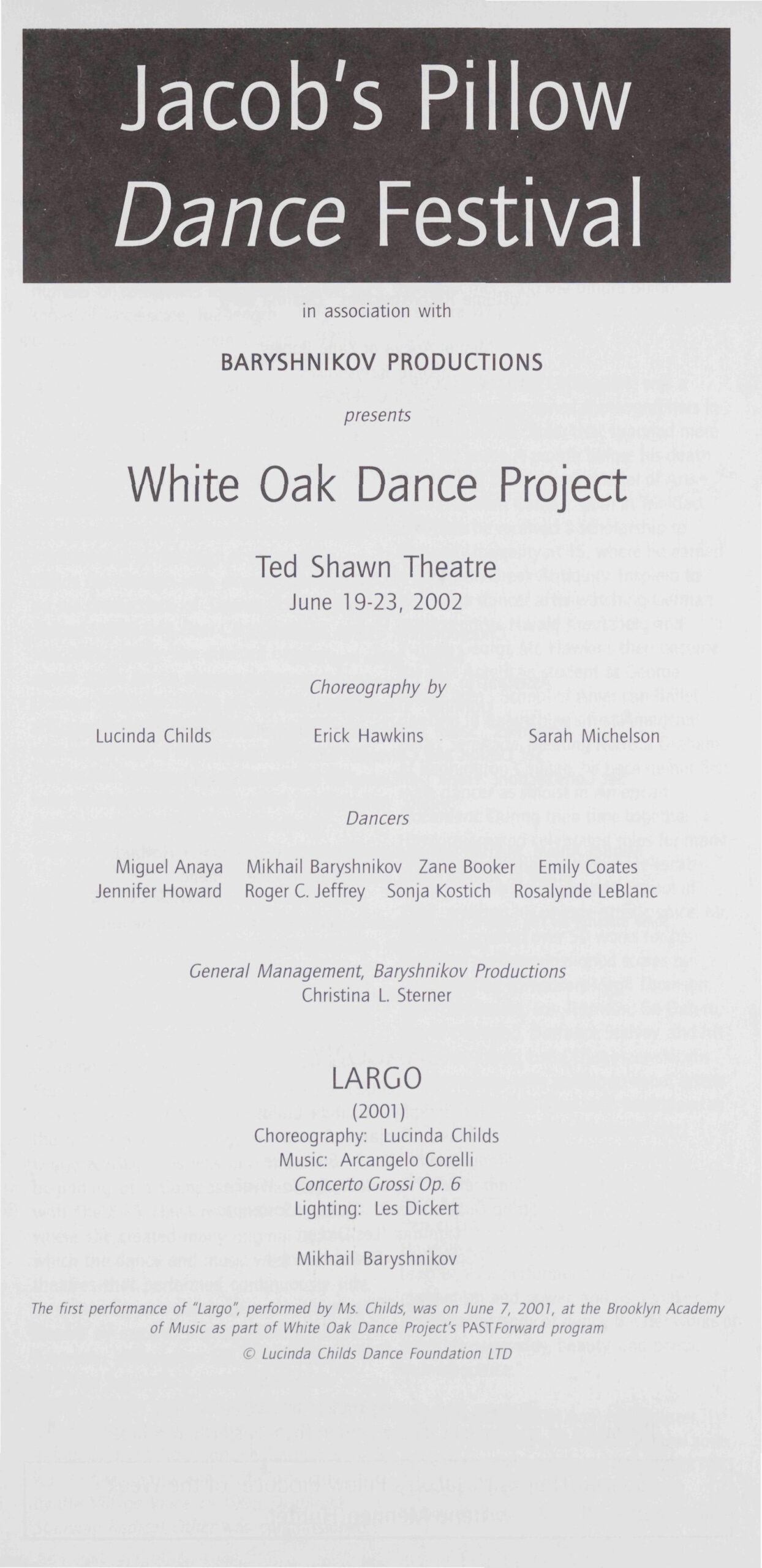
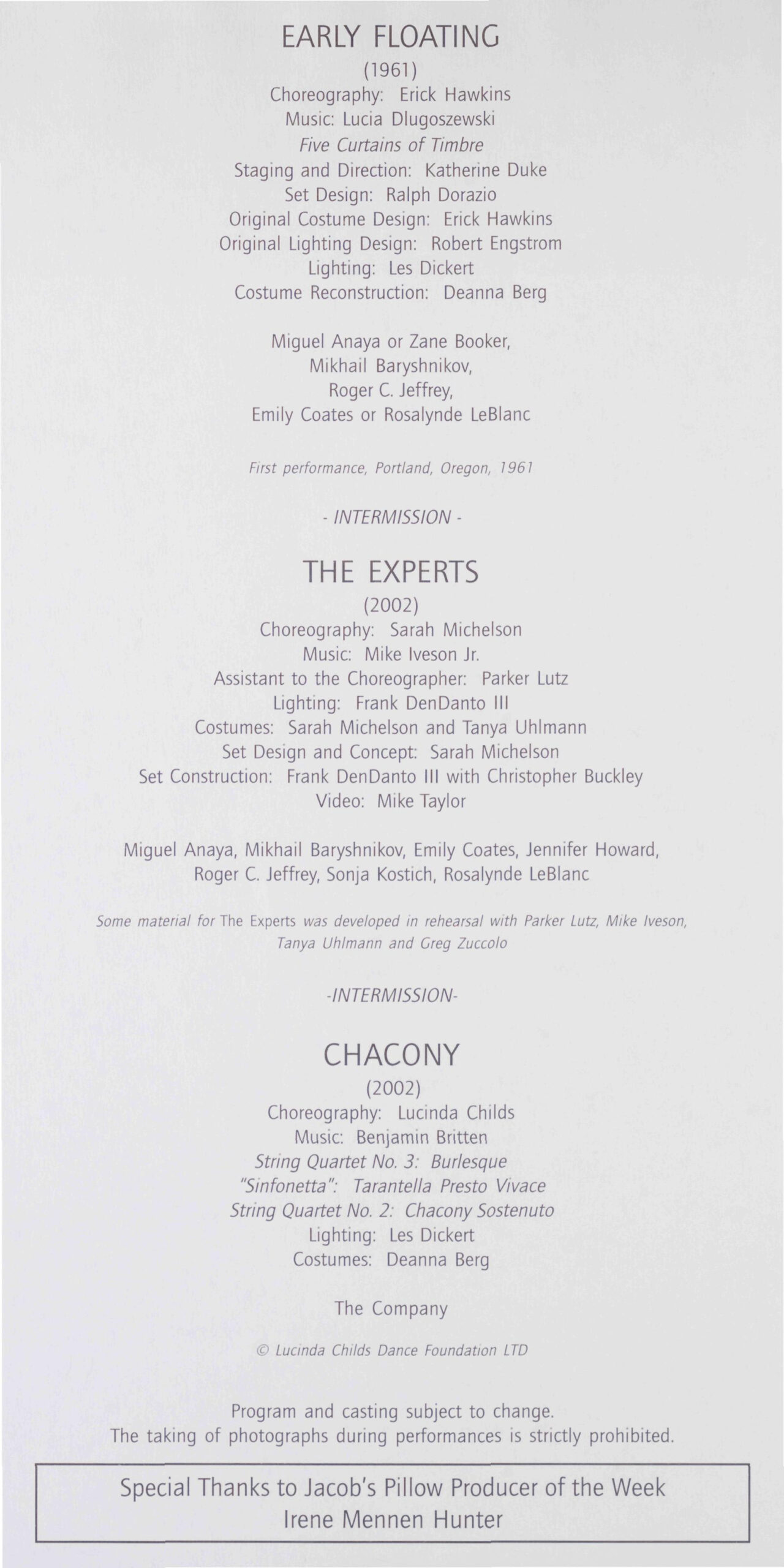
In Chacony, her choreography insists on its own force and logic, rather than succumbing to Benjamin Britten’s intense musical score. Amid the ensemble sections, duets intervene—first between two women, then a man and a woman—inflected by quick directional shifts and leans away from the center. The initial female duet later pairs with male partners, their unison subtly disrupted. They hold hands with the men, but do not regard them in any palpable way. As the women exit together into the opacity of the wings their detachment from the men seems, to this viewer, to hint at an undercurrent of queerness.
Throughout Chacony, gender often feels secondary, even immaterial, yet it is reliant on distinctly gendered groupings, with tighter cohesion within same-gender pairs. The two women I have been tracking from the beginning of the work are the last two to leave in yet another section, sharing the space a moment longer than the others. This lingering presence in Chacony invites interpretation: Is this a queer dance, or am I imposing queerness onto it, seeking traces in the work of an artist I deeply admire? While I understand Childs to be queer, does that inherently render her works queer?
The inverse question is equally compelling: If I interpret a work as queer only to discover that the creator does not identify as queer, does that discredit my reading of it?
Marta Renzi, the first artist featured on the Pillow’s Inside/Out stage in 1983, does not identify as queer, yet her work and writings embody a distinctly feminist, perhaps queer ethos. Though relatively lesser-known, she received a New York Dance and Performance “Bessie” Award in 1992 for Vital Signs, a work that, two years before Bill T. Jones’s seminal Still/Here, engaged in collaboration with terminally ill and injured individuals. Like Jones, she continues to make work today, though much of her recent choreography has been created for film rather than the stage.
Her compiled company newsletters, published in two volumes, offer a unique account of her personal and professional experience, and are a meaningful addition to the archival videos of her dances in the Pillow’s archives. Renzi’s newsletters blur personal and professional, success and failure. They feature conventional successes such as tours, reviews (and her occasional responses), and upcoming engagements, alongside memorials for friends lost to AIDS, journal and letter fragments, recommendations for restaurants in the cities to which she toured, and the birth announcement of her son.
Notably, Renzi also documents her failures and grant rejections. Queer theorist Jack Halberstam argues that failure can be a queer value in The Queer Art of Failure. Halberstam celebrates forgetfulness, spectacular failure, and absurdity, highlighting cultural phenomena deemed immature or insignificant. One critic dismissed Renzi’s work as “embarrassing in its adolescent fascination with sex and dirty words.”1986 review of Renzi’s Soft Sell by Doris Diether in The Villager, quoted by Renzi in her Fall 1986 Newsletter, Volume I.
Marta Renzi does indeed make work that is intensely physical, often addressing sexuality and the experiences of women. Many of them read as heterosexual (she embraces her male partner, he draws his hands up the front of her body), but the way she presents her work invites discontinuity, tangents, and intimacy. In her many performances at the Pillow during the 1980s and 1990s, Renzi frequently stops mid-performance in order to converse with her audience, restart, or seek feedback on her choreography. This inclination toward rupture and deviance feels refreshingly queer amid the impeccably polished works that so often characterize concert dance.
In a 1997 untitled work-in-progress, dancers in hyper-feminine attire transition from polite movements to chaotic lunges, shoe-throwing, and moments of intimacy, only to reassemble into idealized feminine forms. Renzi’s suggestion of the title “The Secret Life of Women” hints at an unspoken experience, and invites queer speculation. In I’m Not Very Pretty, a solo in which Renzi repeatedly debases her own appearance, the recorded text (credited to her husband Daniel Wolff) frequently returns to Jeanette, a recurring image of an attractive peer who “give[s] off this rich, clear light,” evoking the perennial lesbian question: Do I want to be her or date her?
Furthermore, Renzi writes in a 1991 letter to dancer Kristin Draudt published in her newsletter: “At various stages in my life (not my career) I’ve focused on my sexuality—in relation to men, other women, an audience’s expectations.” Certainly this is not a public acknowledgment of her queerness, but is it enough to include her in a discussion of queer choreographers?
José Esteban Muñoz argues that something’s “inability to ‘count’ as proper ‘proof,’ is profoundly queer.”Muñoz, José Esteban. “Ephemera as Evidence” Introductory Notes to Queer Acts.” Women & Performance: a journal of feminist theory, vol. 8, no. 2 (1996): 5-16. DOI: 10.1080/07407709608571228 Insisting on orderly and seamless categories when it comes to sexual expression and identity can further reinscribe the very harms we seek to avoid. Though Marta Renzi is married to a man and has children, her work feels unmistakably queer to me. By embracing failure, disrupting performance conventions, and focusing on gender and sexuality—often shifting between multiple, sexually-charged relationships rather than fixating on one—Renzi’s work offers a powerful model, presenting alternative ways of being in the world, a body, and a performance context.